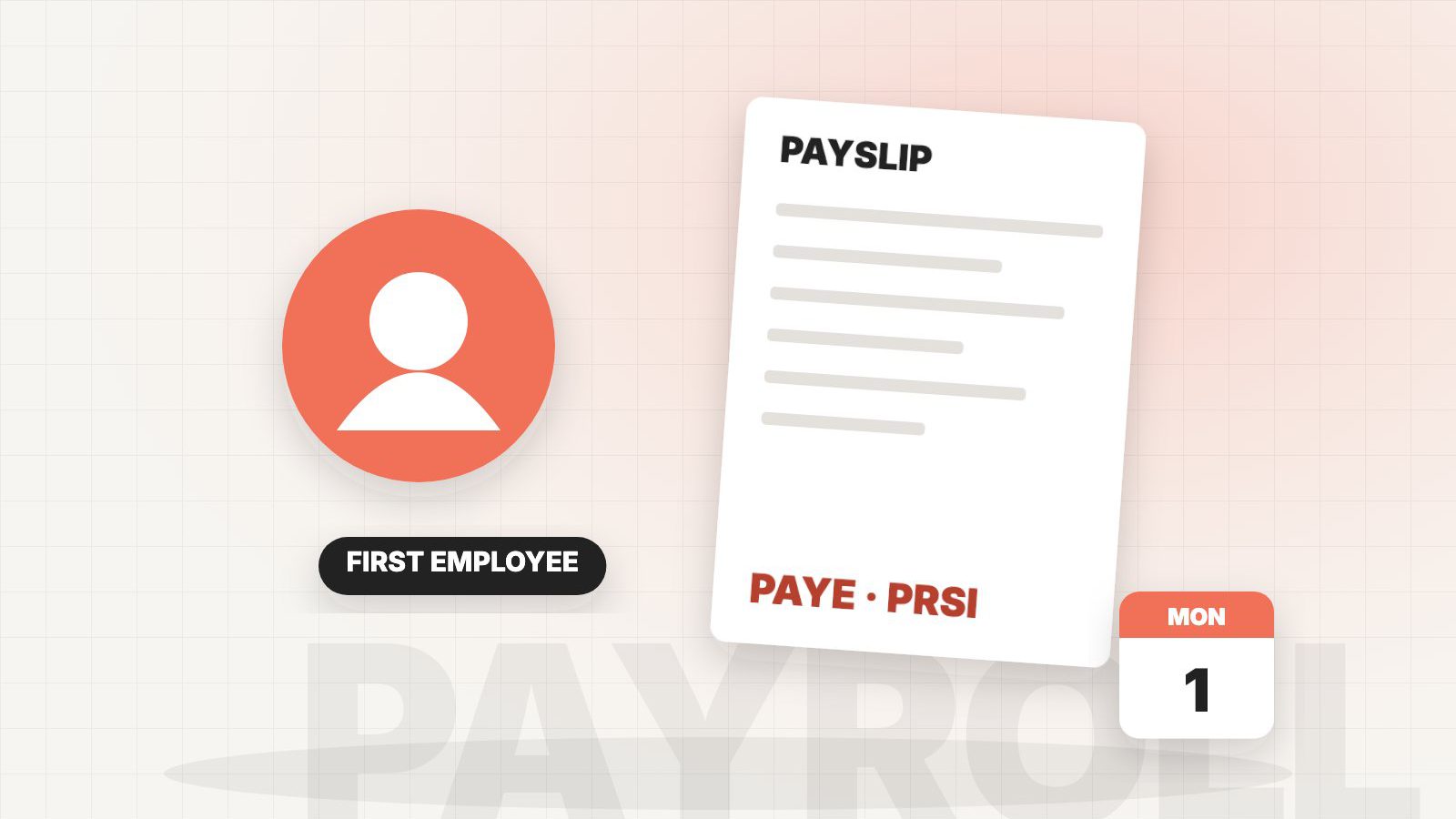
Taking on your first employee is a big step for a small business. Payroll for your first employee cannot be “switched on later”: the very first wage has to be calculated correctly and reported to Revenue on or before the day you pay it. Here is what to sort out in advance.
What payroll means in Ireland
Payroll is calculating and paying wages, with tax deducted. In Ireland the employer deducts PAYE (income tax), USC (Universal Social Charge) and employee PRSI (social insurance contributions) from wages, and also pays employer PRSI. All of this is reported to Revenue in real time – every time you pay wages.
Payroll for your first employee: registration and paperwork
- Employer registration. Before the first payday, you must be registered with Revenue as an employer. If you already have ROS (Revenue Online Service) access, this is usually done through ROS.
- Payroll software. Wages are reported through Revenue-compatible payroll software or through ROS. This is usually done by your accountant.
- Terms of employment in writing. At present, an employer must give the employee the core terms of employment in writing (the parties, start date, pay, working hours and so on) within five days of starting work, and the remaining terms within a longer set period. Check the exact list in official sources.
- Employee details: full name, PPSN (Personal Public Service Number), start date, pay and how often they are paid.
The employee, for their part, should register the new job in myAccount (Revenue’s online service for individuals), so that Revenue can allocate their tax credits.
Employee or self-employed?
Before you start, make sure the person really will be your employee. If they work the hours you set, with your equipment and under your direction, it is usually employment, even if they would prefer to work as a Sole Trader. Revenue looks at the real situation, not at what the contract is called. If the relationship is assessed incorrectly, you may later have to recalculate tax and employer PRSI for the past period.
What to agree with the employee before day one
- gross pay, and whether it is hourly or fixed;
- pay frequency (weekly, fortnightly or monthly) and payday;
- working hours, annual leave arrangements and how working time will be recorded;
- the bank account wages will be paid into.
The first payday: the RPN and reporting to Revenue
Before each payment, the payroll software retrieves an RPN (Revenue Payroll Notification) from Revenue – the employee’s tax credits, rate band and USC details. Deductions are calculated from these. If there is no RPN for the employee yet (for example, they have not registered the job or do not have a PPSN), emergency tax applies – higher temporary deductions until the situation is sorted out.
Then:
- the wage and deductions are calculated;
- a payroll submission is made to Revenue – no later than the payment date;
- the employee receives a payslip showing all deductions;
- Revenue prepares a monthly statement based on your submissions, and the tax deducted is paid by the set deadline – currently usually by the 23rd of the following month if you pay through ROS.
A practical example
Example (illustrative, without tax calculations): an employee starts on 3 March and is paid monthly on the 28th. By 28 March you must be registered as an employer, and the employee must have registered the job in myAccount. On or before 28 March, the payroll software retrieves the RPN, calculates deductions on, say, €2,800 gross and makes the submission to Revenue. The employee receives the net amount and a payslip. You pay March’s deductions and employer PRSI based on Revenue’s statement – currently usually by 23 April.
Other employer obligations in 2026
- National Minimum Wage. Based on 2026 figures, the national minimum hourly rate for an adult employee is €14.15. Check the current figure in official sources.
- Pension auto-enrolment. Since the start of 2026, a new system has been in place under which certain employees without a workplace pension are enrolled in a savings scheme, and the employer also pays contributions. It is worth finding out in advance whether it applies to your employee.
- Records of working time, leave and pay. These must be kept properly, as they may be requested not only by Revenue but also by the employment rights inspectorate.
- Changes. If an employee leaves, this is also reported through payroll by submitting their final payment with the leaving date. If pay or hours change, the new details must be entered before the next payment.
Common mistakes
- Paying wages and reporting to Revenue afterwards.
- Paying the employee “in cash for now” until registration is sorted.
- Using an old RPN, or calculating without one.
- Treating the person as self-employed when in substance they work as an employee.
- Forgetting to pay the monthly statement or to check that it is correct.
What an accountant can do
An accountant can help you register as an employer, run payroll for you, make the submissions to Revenue every pay period, prepare payslips and remind you of payment deadlines. What is left for you is to report changes: new employees, hours, bonuses, leave or someone leaving. Read more about employer obligations in our article payroll in Ireland for employers.
Quick answers
Can I pay an employee who does not have a PPSN yet?
Yes, but payroll must still be run and reported to Revenue, and deductions will be calculated under emergency tax until the situation is sorted out.
Do I need to file an annual employer return?
Under the current real-time system, details are reported every time you pay wages, so there is no longer a separate annual return as there was in the past.
Can my first employee be a family member?
Yes, but payroll still applies. Specific PRSI rules may apply to family members, so it is worth discussing this separately.
Well-prepared payroll for your first employee helps you avoid mistakes from the very start. Always check the current rules on revenue.ie.
If you need help with your own situation, see our payroll services in Ireland or get in touch.
This article provides general information, not individual tax advice. Rules change — talk to us about your own situation or check the official Revenue information.