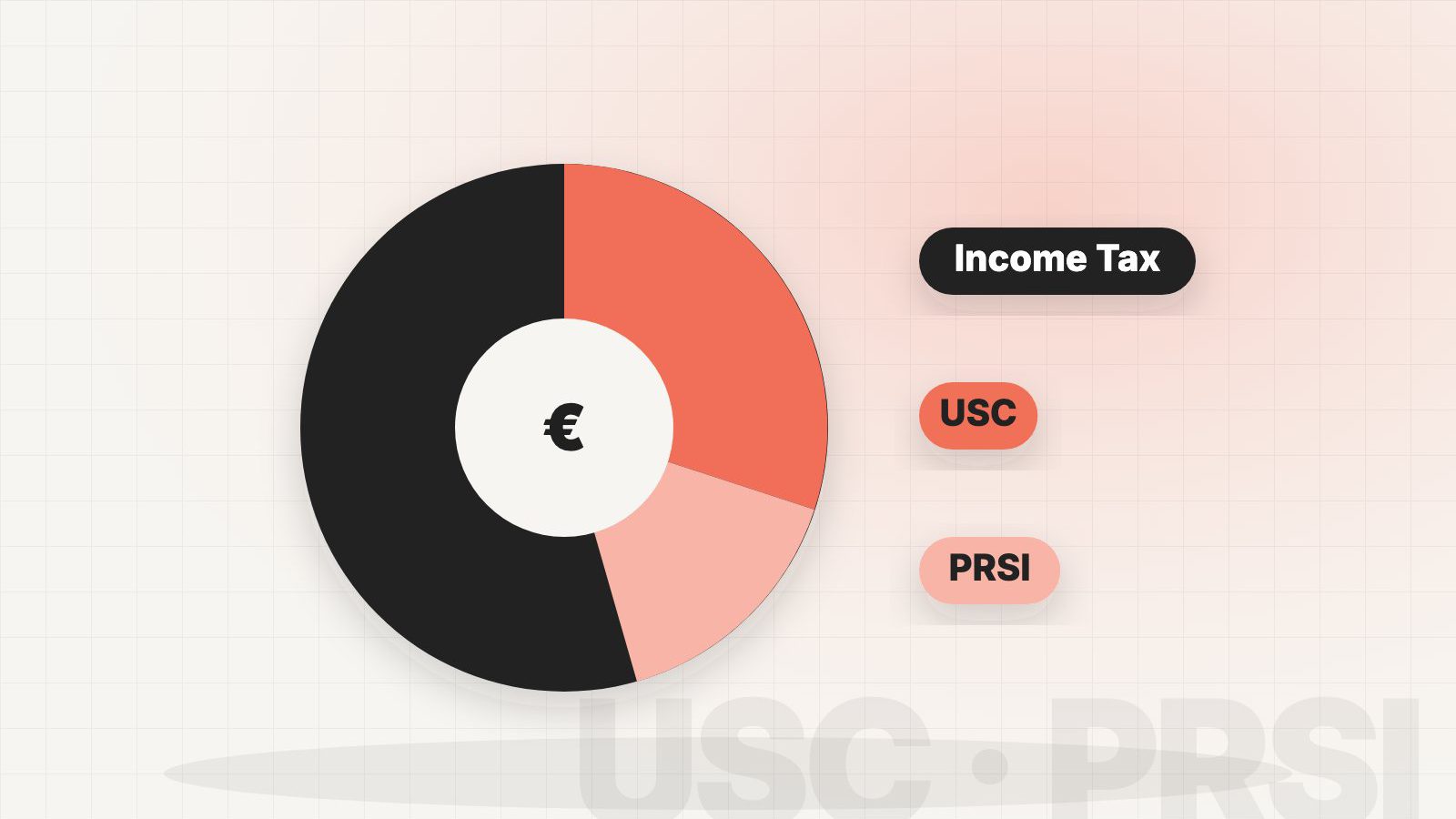
A self-employed person in Ireland pays not one but three different charges on the same profit. As well as Income Tax, USC and PRSI are calculated separately, and each has its own logic. If you try to “fold everything into one percentage”, the figure at the end of the year will probably surprise you.
Three charges on the same profit
A Sole Trader’s profit (income minus business expenses) is declared on the annual Form 11 return. Three charges are calculated on that same profit:
- Income Tax – reduced by your personal tax credits.
- USC – the Universal Social Charge, a separate progressive charge on income.
- PRSI – Pay Related Social Insurance, your social insurance contributions.
The key point is that tax credits only reduce Income Tax. They do not reduce USC or PRSI, which is why someone with a modest profit sometimes pays USC or PRSI even though they pay almost no income tax.
What USC is
USC is charged in income bands: the higher the slice of income, the higher the rate on it. Based on 2026 figures, the standard USC rates are 0.5%, 2%, 3% and 8%. The band limits are often changed in the Budget, so we check the exact amounts on revenue.ie every year.
- At present, if your total annual income is €13,000 or less, no USC is payable at all.
- For self-employed people with non-PAYE income above €100,000, an extra 3% USC currently applies to the part above that amount (11% in total).
- Reduced rates apply to some groups (for example, certain medical card holders or older people on lower incomes) – the conditions need to be checked individually.
What self-employed PRSI is
Self-employed people pay PRSI Class S. At present it is payable if your annual income is €5,000 or more. The contribution is a percentage of your so-called reckonable income – not just your trading profit, but also some other income, such as rent. There is also a minimum annual contribution.
PRSI rates have been increased in stages in recent years, usually from October, so we do not quote a specific percentage in this article – check the current rate on revenue.ie or gov.ie. PRSI generally no longer applies once you reach 66.
What Class S contributions give you
PRSI is not “just another tax”. The contributions you pay build up entitlement to social welfare payments, such as the State Pension (Contributory), Jobseeker’s Benefit (Self-Employed), Maternity Benefit or Treatment Benefit. Not every benefit available to employees applies to the self-employed, so it is worth checking a specific entitlement with the Department of Social Protection.
USC and PRSI: how it differs from a PAYE payslip
For an employee, the employer deducts USC and PRSI (usually Class A) every month, and the payslip shows the final figure. When you are self-employed, nobody deducts anything: the tax is worked out for the whole year, declared on Form 11 and paid by you, including the advance payment known as Preliminary Tax.
When you have a job and your own business
Many people work under PAYE and run a Sole Trader business on the side. In that case USC is calculated on all your income together, and the amount already deducted through PAYE is credited on your return. PRSI may be paid both ways: Class A through your employer and Class S on your self-employed income, if it reaches the threshold. So “my payslip shows everything is paid” does not necessarily mean you will have nothing extra to pay.
A practical example
Example (illustrative figures): Rose is a Sole Trader providing cleaning services. Last year’s Form 11 showed that her Income Tax, USC and PRSI came to €7,800 in total. This year her income is similar, so every month she moves €650 (€7,800 / 12) into a separate account.
In October she will need to pay last year’s balance (if any) and this year’s Preliminary Tax. Because the money has been set aside in advance, the payment is not a shock. Note that this €650 is not a “USC and PRSI rate” – it is only a rough amount based on last year’s actual figures. The real split between each charge will only be known once Form 11 is filed. If income rises sharply during the year, it is worth reviewing the amount you set aside with your accountant rather than waiting for the return.
Why planning ahead matters
Tax for the self-employed builds up over the whole year but is paid in one or a few large payments. To avoid a shock at Pay and File time:
- Keep records of income and expenses every month, not once a year.
- Put part of every payment you receive into a separate account for tax.
- Estimate USC and PRSI separately from Income Tax – credits do not reduce them.
- If your income changes, review your plan in the same year.
For the bigger picture of self-employed tax, see our article tax for the self-employed.
Common mistakes
- Assuming tax credits will also reduce USC and PRSI.
- Using last year’s rates or bands from out-of-date information.
- Forgetting that Class S PRSI can also be charged on rental or other income.
- Assuming that, because you have a PAYE job, there is nothing extra to pay on your self-employed income.
- Not setting money aside for tax, so it simply is not there when the return is due.
Quick answers
Do tax credits reduce USC?
No. Tax credits only reduce Income Tax. USC and PRSI are calculated separately under their own rules.
Do I have to pay PRSI if my self-employed income is very low?
At present, Class S PRSI is payable if your annual income is €5,000 or more. Below that, the contribution generally does not apply, but this can affect your future social welfare entitlements.
Where do I pay USC and PRSI?
If you are self-employed, together with Income Tax, through your Form 11 and Preliminary Tax payments to Revenue. You do not need to make separate payments for each charge.
Once you understand how USC and PRSI work, you can plan your income more realistically and avoid unpleasant surprises.
If you need help with your own situation, see our tax advice in Ireland service or get in touch.
This article provides general information, not individual tax advice. Rules change — talk to us about your own situation or check the official Revenue information.